Photo/picture frames bought from a retail store often include a sheet of clear plastic. This may be the cheapest material possible and you may want to replace it with higher quality glazing.
In photo/picture framing, “glazing” is a generic term meaning a clear sheet protecting the artwork. It may be glass or acrylic, but I have never heard of clear plastic referred to as glazing.
When preparing a photo exhibit last year, some of the frames I purchased included clear plastic sheets and I opted to replace them with non-glare acrylic. However, at the last minute, I ran short of acrylic sheets and shipped two pieces with just the plastic that came with the picture frames.
If you try to buy glazing from a local frame shop or art-supply frame shop, be prepared for sticker shock; it can be very expensive. I buy clear acrylic sheets on-line.
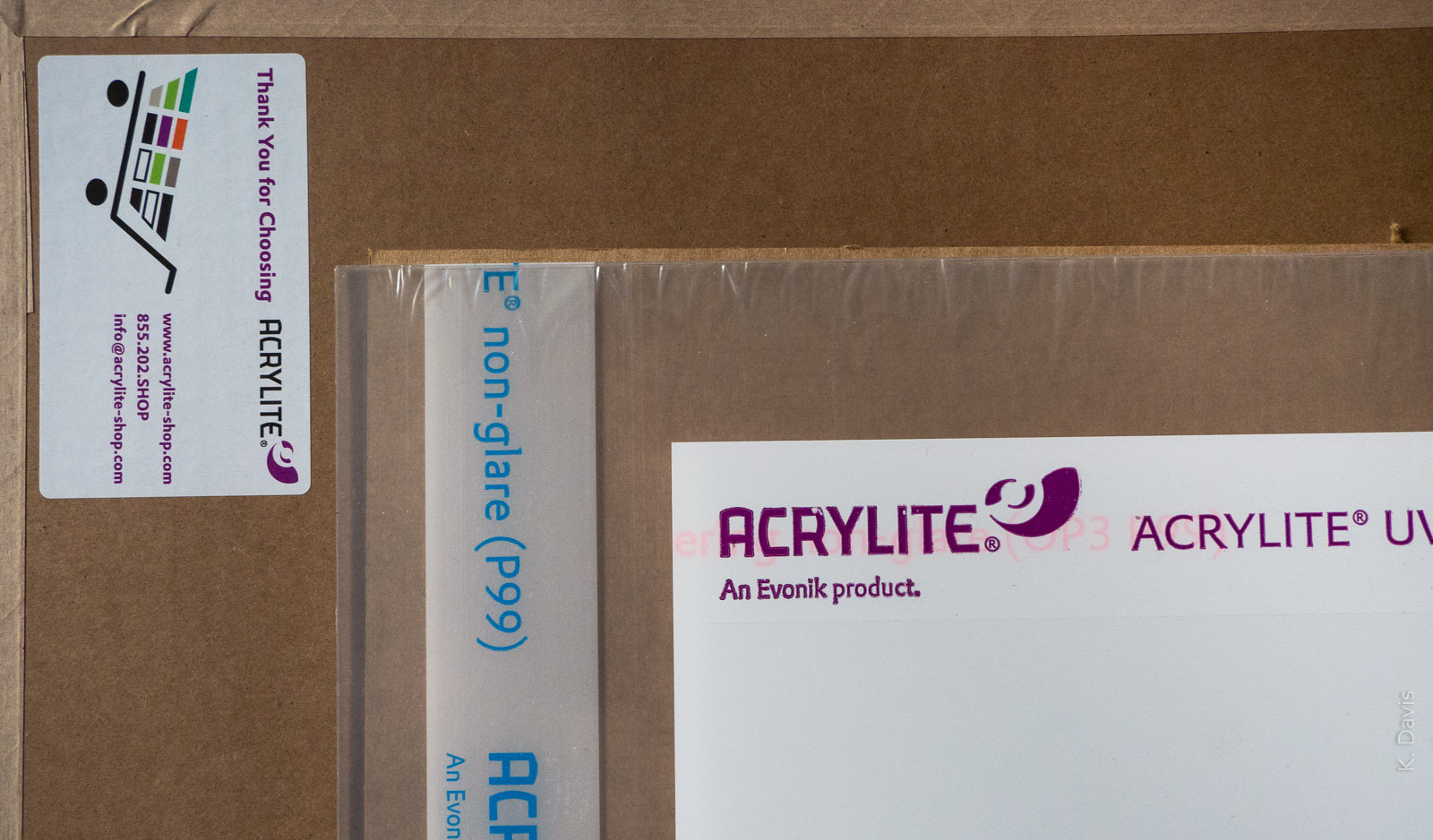
The introductory photo here shows a recent delivery that included some Acrylite P99 and Acrylite OP3 P99. The shipping packages were ruggedly constructed with solid wood edges and built to the exact sizes for the sheets that I ordered.
Glass
Glass can be great, but has limitations. It typically offers the highest level of light transmission and the best resistance to scratches. However, it is both heavy and famously brittle – likely to break if dropped. Shipping framed artwork with glass is quite problematic.
Your local hardware store may sell sheet glass; some stores will cut it to any size you need. But this is typically thin glass for windows. Hardware stores do not generally sell non-glare or UV-resistant varieties intended for framing.
Anti-reflection (non-glare) glass
To reduce reflections/glare, AR glass may either have a surface coating or be laser-etched. Single-sided AR glass is conditioned on one side only. You place that side outward toward the room, while the smooth size faces your artwork. Therein lies the possibility of internal reflections, the artwork reflecting off the glass. Double-sided AR glass is conditioned on both sides; it is typically very expensive.
I have used double-sided etched glass, which was superb; but I later abandoned it because of the expense. For a single-sided AR glass, the brand name I trust is Tru Vue. (Tru Vue offers both glass and acrylic glazing products.)
UV-resistant glass
This protects your art from fading and discoloration due to UV light. This can be important if you intend to display the art in a location exposed to sunlight. It may also be important to protect old documents; it is commonly used in museum displays.
Clear Acrylic
Compared to plastic, acrylic will not turn yellow or brittle with age. Compared to glass, acrylic is less weight and very resistant to breaking. Acrylic is often sold as trade names such as Plexiglass, Lucite, Perpex, and Acrylite. (The technical name is PMMA … polymethyl 2-methylpropenoate or polymethyl methacrylate.)
Each acrylic sheet (weather purchased individually or as part of a complete frame) is typically coated on both sides with a thin protective skin that you must peel off. As this protective skin may be transparent, you may not initially know that it is present. Be sure to remove it before final assembly of your photo/picture frame; if you forget until after the sheet is in the frame, you will have to disassemble everything in order to peel the skin off.
As with glass, your local hardware store may sell clear acrylic sheets, but not non-glare and not UV-resistant varieties.
Clear acrylic sheets are available in different thicknesses. I’ve used 0.098” (1/10th inch) and 0.080”. The latter works perfectly well for sizes up to 20×30. I don’t really see the need for 1/10 inch.
Anti-reflection (non-glare) acrylic
Under the Acrylite brand, the anti-reflection version is called P99.
UV-resistant acrylic
Under the Acrylite brand, anti-reflective sheet products include FF3, UV3 and OP3. FF3 is manufactured with a casting process (not extruded) that is less expensive than the other two. OP3 filters out a bit more UV light than does UV3. Some third-party vendors neglect to inform you which specific product they are selling.
For a combination of both anti-reflection and UV-resistance – that is OP3 P99. I believe FF3 is only available with high-gloss surface, not non-glare.
Acrylic photo prints
A photograph can be directly printed onto a sheet of clear acrylic. This requires a unique sheet product with adhesion properties. Under the Acrylite brand, this is DP MR1.