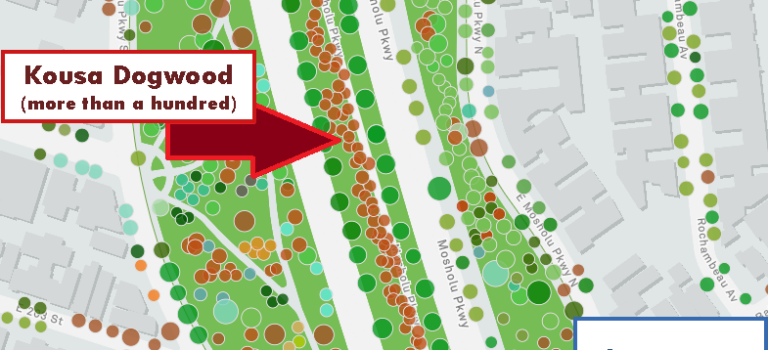
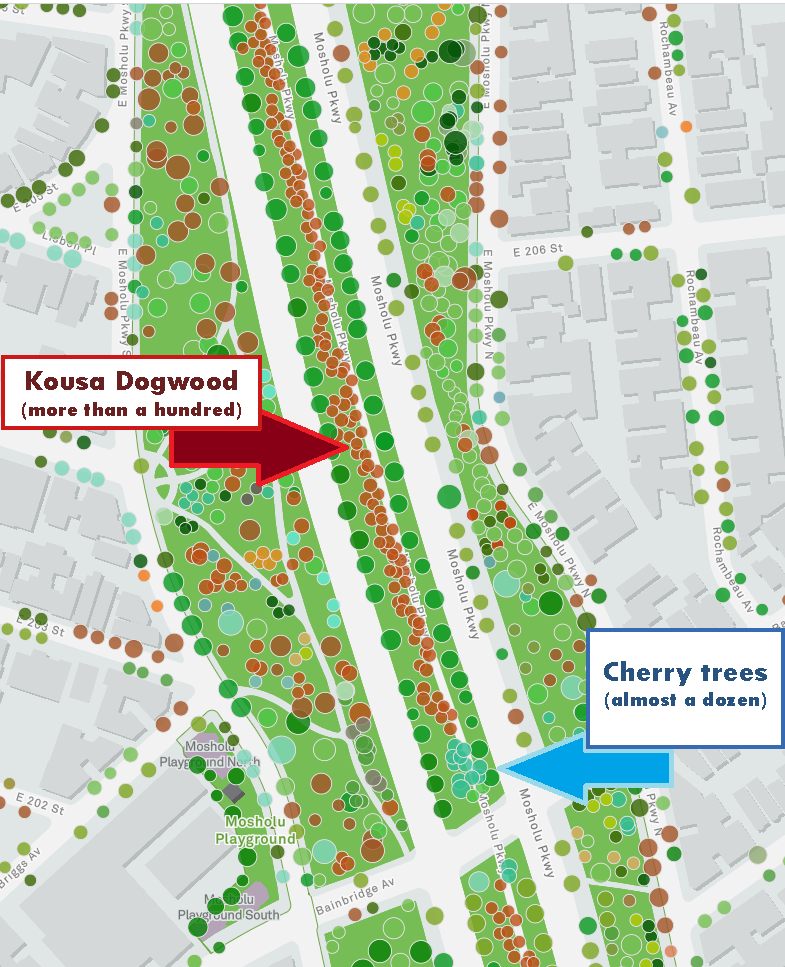
Available free online, some cities have detailed interactive maps of all trees. Well, maybe not ALL trees. Most maps have some errors or missing data, perhaps because the data is not perpetually verified and maintained. Some maps are specifically “street trees”, meaning it may not include trees in parks or on privately-owned land.
Sometimes a map may show the genus, but the exact species of a tree is not known.
You might use one of these maps to identify the species for a particular tree. Or you might use it to locate unknown instances of a specific species you are seeking.
Here are some links to online tree maps that I have found helpful.
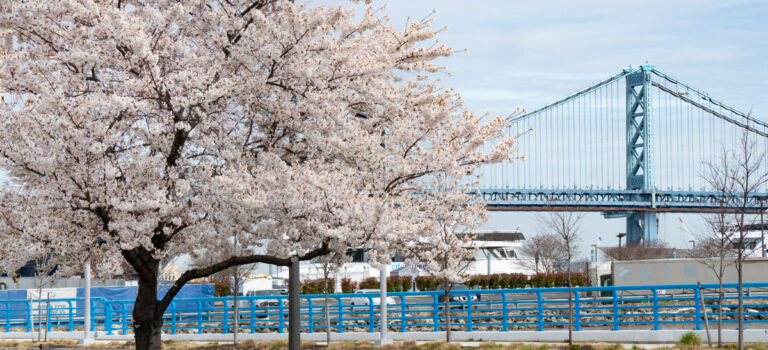
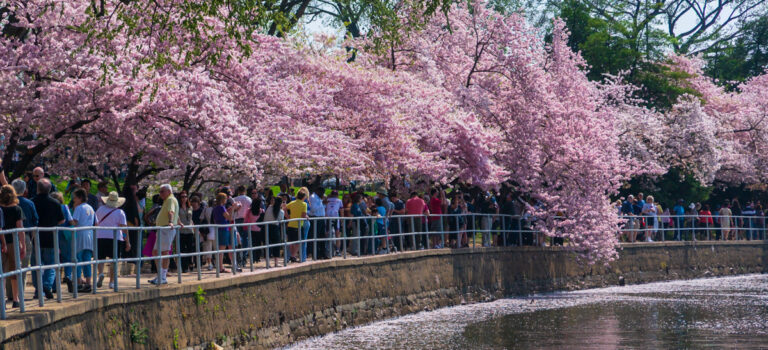
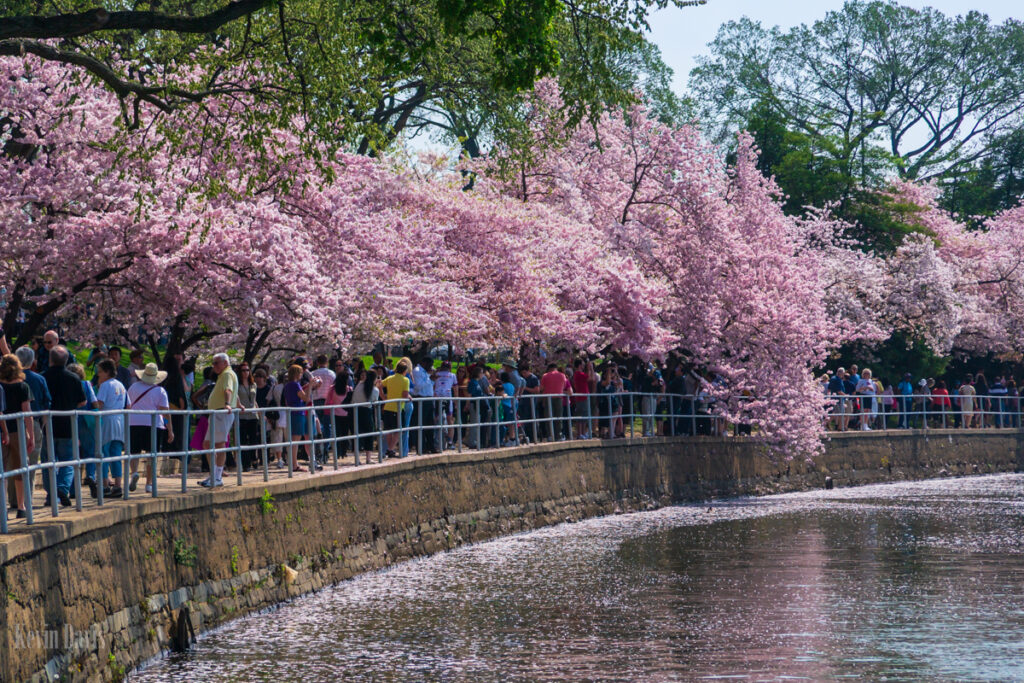
Despite cold weather in February, cherry blossoms in Washington D.C. bloomed earlier than expected. The National Park Service declared peak bloom at the tidal basin March 26. My early prediction (ten days ago) was off by four days.
Much like a dashboard GPS device might say … “Recalculating …”
March 26 : Peak bloom at Washington D.C. March 31 : Kwanzan (late-season cherry) begin bloom at Washington D.C. April 7 : Peak bloom at Philadelphia April 15 : Kwanzan (late-season cherry) begin bloom at Philadelphia April 19 : Peak bloom at Boston April 27 : Kwanzan (late-season cherry) begin bloom at Boston
March 1st, I wrote this to a friend: “Temperatures in January & February 2026 were colder than average, which may suggest peak bloom first week of April. However, the National Weather Service is predicting warmer than average temperatures in March, which would accelerate it to end of March.”
March 12 in Washington, the range of predictions regarding peak bloom at the tidal basin suggest March 28 at the earliest and April 7 at the latest. Currently in Washington D.C., according to the National Park Service, the early-blooming Okame Cherry trees were in bloom while the Yoshino Cherry trees at the Tidal Basin had reached the florets visible stage.” While Okame flowers may be affected by frost this week, blossoms that have not yet appeared and will not be affected.
On March 17, both D.C. and Boston will experience a hard freeze as temperature drops below 30º F (-1º C). Furthermore, most of this week, the daily high temperatures in Washington D.C. are very similar to temperatures in Boston Massachusetts. That’s unusual.
Unless the weather in D.C. does something very peculiar in the next 10 days, Yoshino peak bloom should hit between March 30 to April 2.
Boston
In light of how the season is developing in Washington D.C., what does that imply for cherry bloom around Boston? It’s really too early to predict, but … maybe the Okame Cherry begin blooming by mid April and the Yoshino peak bloom around last week of April.
Though it is true that spring weather advances from south to north, the progression is variable from year to year. Some years, spring progress can stall around New York City such that all points north remain on the cold side and flowering trees bloom late. Unfortunately, a prediction of winter’s end from Punxsutawney Phill is useless.
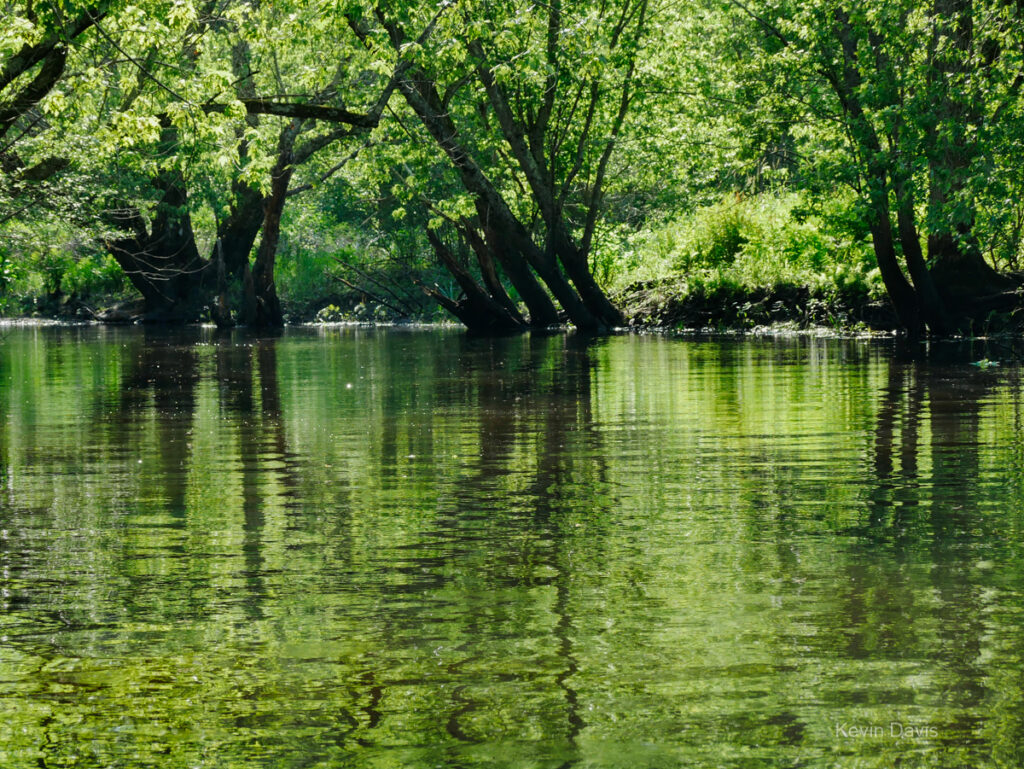
For an afternoon paddle that day, I considered a few options from Middleton to Ipswich. I loaded my canoe atop my car, tied it down, then drove to the boat launch at High Street.
Having paddled here a few times before, I knew well that a wrong turn can easily lead down the Beverly-Wenham Canal. After using a maps app on my smartphone to double-check my orientation, I stowed the phone in a dry bag and then pushed off, heading upstream.
After beginning my trip with a single-blade canoe paddle, I switched to a double-blade kayak paddle when the canoe paddle struck the river bottom. A double-blade paddle requires less water depth but also requires five or six feet width. The river is generally quite wide from Middleton to Ipswich.
The current of the Ipswich River can be strong during high water. Today, the current was slow and this was no surprise. Up-river in North Reading, a depth gauge had shown less than twelve inches.
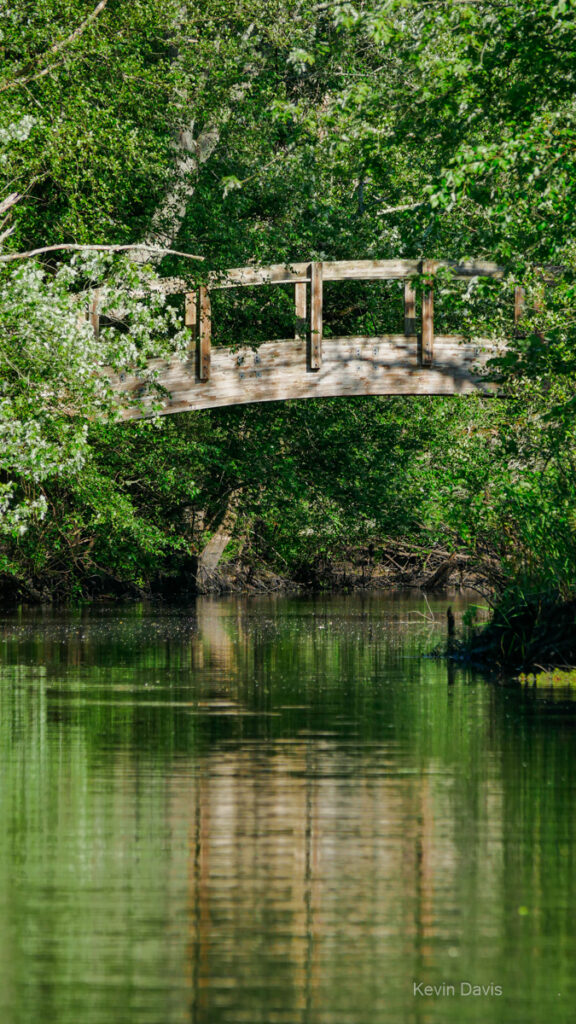
I came upon a wooden arch bridge over the river. Built upon concrete piers, this bridge looked quite nice and was high enough to allow any and all paddlers pass beneath. Yet I could see that both ends of the bridge were intentionally blocked to disallow foot traffic. Pulling my canoe to a stop in some grass, I retrieved a camera from my dry bag and photographed the bridge.
A bit further on, multiple large trees had fallen across the river. Getting past these obstacles would take some work and I debated continuing on or turning back. I pressed onward. After negotiating with a deeply muddy embankment, I pulled the boat ashore, dragged it fifty feet across the grass, taking care to avoid poison ivy, and put back into the river. At a different tree across the river, I pulled alongside the log, climbed out, and muscled the canoe over.
At an automobile bridge over the river, a couple stood at the rail to enjoy the river. I paddled under the bridge and then checked my smartphone to know the exact road. Rowley Bridge Road – my turn-around point. I thought of friends who lived nearby, but the daylight was waning and I did not have time to go visit them.
The return trip downstream was a bit faster than paddling upstream. But of course I had to again navigate around the downed trees.
When branches are bare and snow is rare … that’s stick season. As nature turns grey and quiet, it’s the worst time of year for nature photographers.
Ski Season
When temperatures will allow snow on the ground … that’s ski season. In northern New England. ski resorts (with snow-making equipment) will typically open in November and close in April.
Love It Or Leave It (a.k.a. Winter)
When natural snow falls and often hangs around for a while … that’s winter. While many people enjoy winter activities such as skiing, snowmobile … many New Englanders dream of sipping cocktails at a tropical beach far away.
Mud Season
When wet soil can suck the boot off your foot … that’s mud season. Late March to early May (possibly until Memorial Day), trails may be closed to hikers, ATVs, off-road bicyclists, and cross-country skiers. The Green Mtn Club annually suggests that people avoid trails during mud season because oversaturated soil is vulnerable to both soil compaction and erosion.
Flower Season
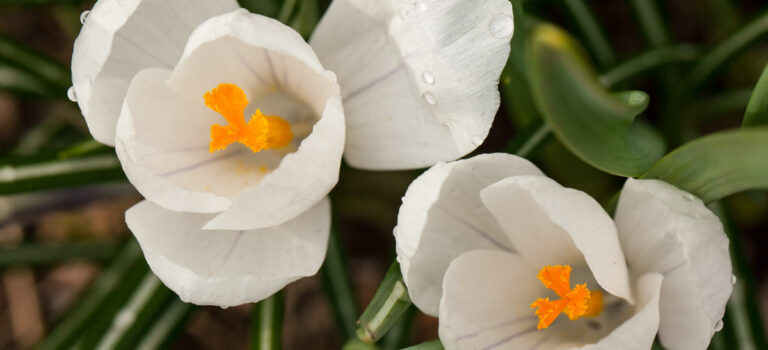
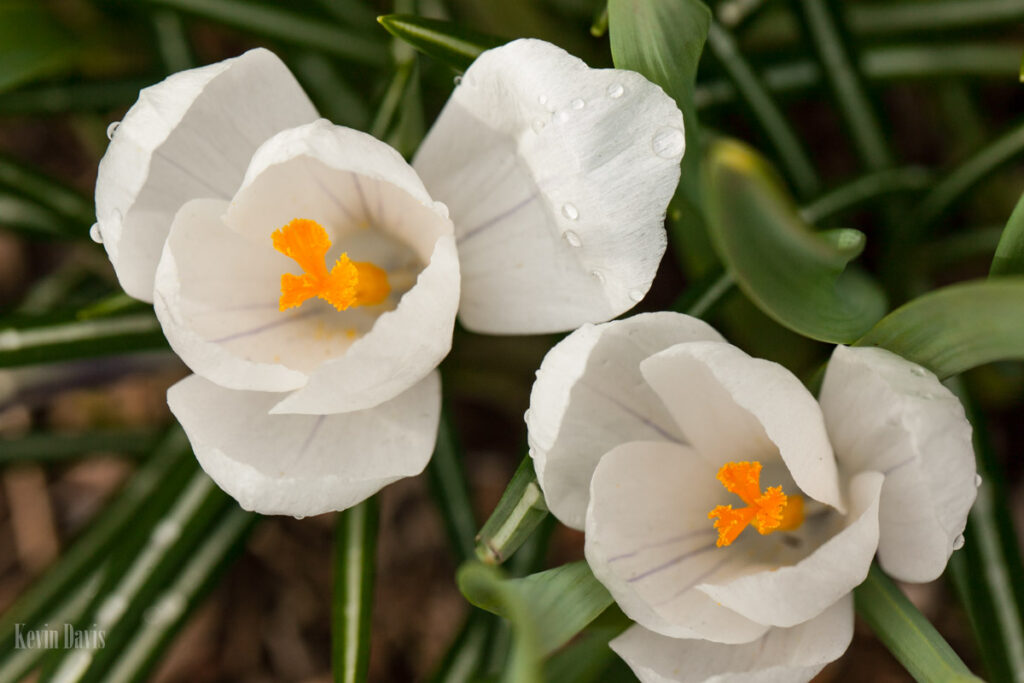
When a flowerless world begins to flower, when trees put on a new coat of leaves … that’s springtime. Crocus can emerge when snow still lies on the ground. When daffodils bloom, then we know all others are soon to follow. Different species will begin blooming at different times, most from mid April through June.
Flowering-Tree season
When flowers adorn the treetops … that’s flowering tree season. Around southwest Connecticut, Magnolia can flower in late March. Then flowering cherry trees; then crabapple. Around northern New England, Dogwood ends the season around the start of June.
Beach Season (a.k.a. Summer)
When people go to the beach and lie in the sun … that’s summer. Animals roam and browse freely; people roam too, with their warm coats stowed away in closets.
Lobster Season
When lobsters are most active and most abundant … that’s lobster season. Though lobster fishing is active year-round, peak catch is between late June and late December.
Dog Days
When temperatures are sweltering … that’s Dog Days Late July to mid August; “dog” days coincides with the year’s heliacal rising of Sirius (in constellation Canis Majoris).
Foliage season
When green treetops are replaced by other colors … that’s autumn foliage “The reason I far prefer the autumn to the spring is because in autumn one looks up to heaven – in spring at the earth.” Soren Kierkegaard.
And of course …
“When the world seems to shine like you’ve had too much wine … that’s amore.”
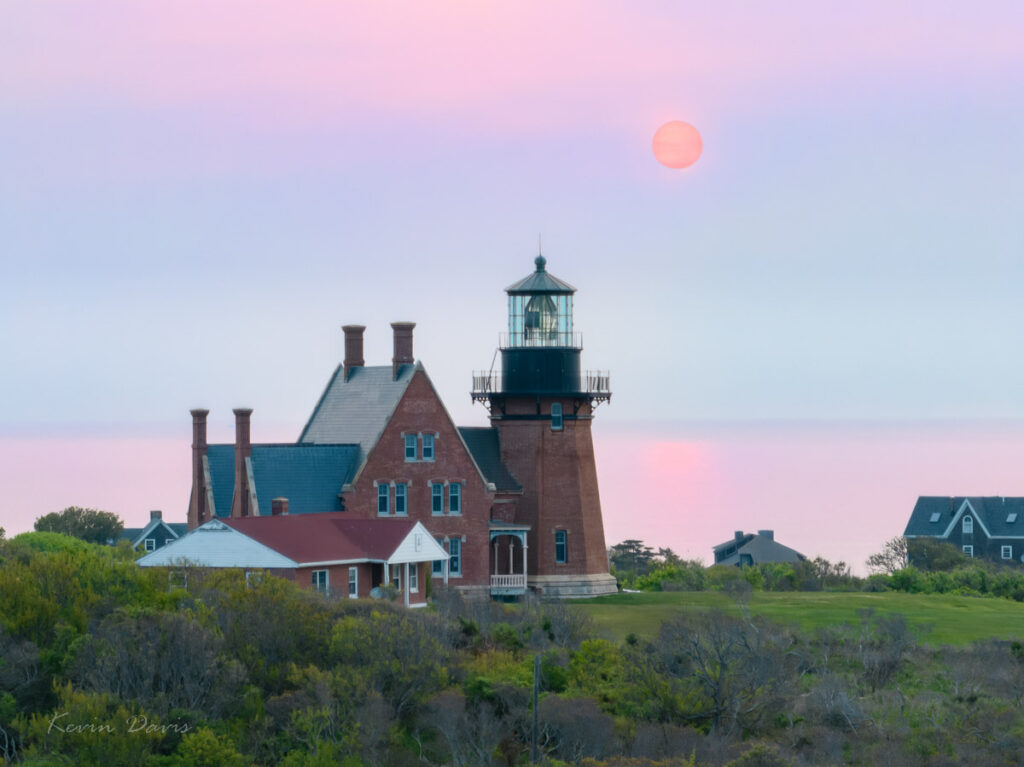
At the time for sunrise (about 5:39 am), the skies were entirely a grey haze and the sun did not show. After waiting four or five minutes with a drone in the air, I abandoned hope and packed up my gear. Walking back toward the road, only then did I see the red disc had risen through the haze. For a brief moment, I pondered whether to simply enjoy the spectacle or quickly re-deploy my gear; I chose the latter.
In retrospect, the haze was more than just morning fog; it was smoke in the atmosphere from Nova Scotia wildfires that month. ‘Cause that will filter light unlike normal morning fog.
Mostly (not completely), I’ve learned not to be disappointed when sunrise doesn’t manifest brilliant colors. That’s challenging because arriving at a location before sunrise implies effort to get up early enough to travel to my intended location. In this particular case, I had to travel by bicycle … before dawn. Because getting a car onto the island is a bit difficult, I left my car on the mainland. And although motorized scooters are common on the island, they are prohibited by law at this time of day.
I love the season of flowering trees; sadly, in the northeast, the season only lasts maybe six weeks.
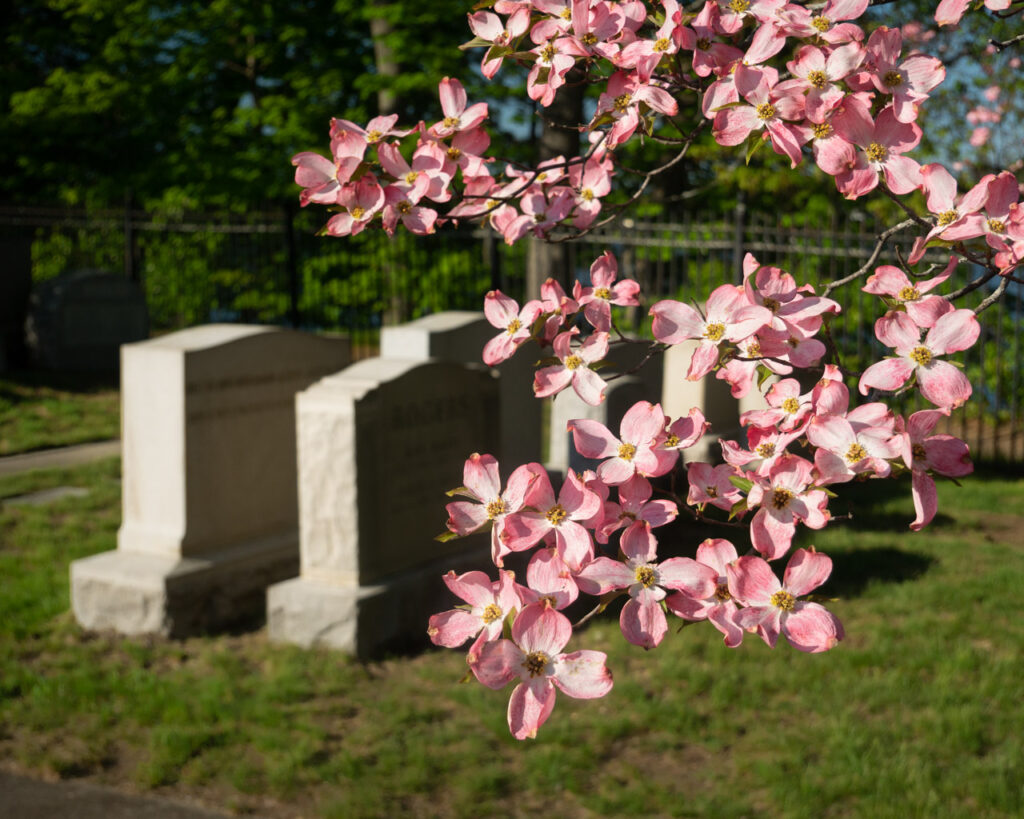
Ornamental flowering trees are commonly planted in many different spaces ranging from residential gardens to corporate office parks. One category that commonly hosts plantings of beautiful trees is cemeteries. While it may seem odd to some people, I’ve seen people of all sorts and ages strolling through cemeteries, even having a picnic. Last weekend, I visited a cemetery in Wakefield. Although the crabapple trees had all dropped their colorful petals, I counted more than two dozen dogwood trees in bloom.
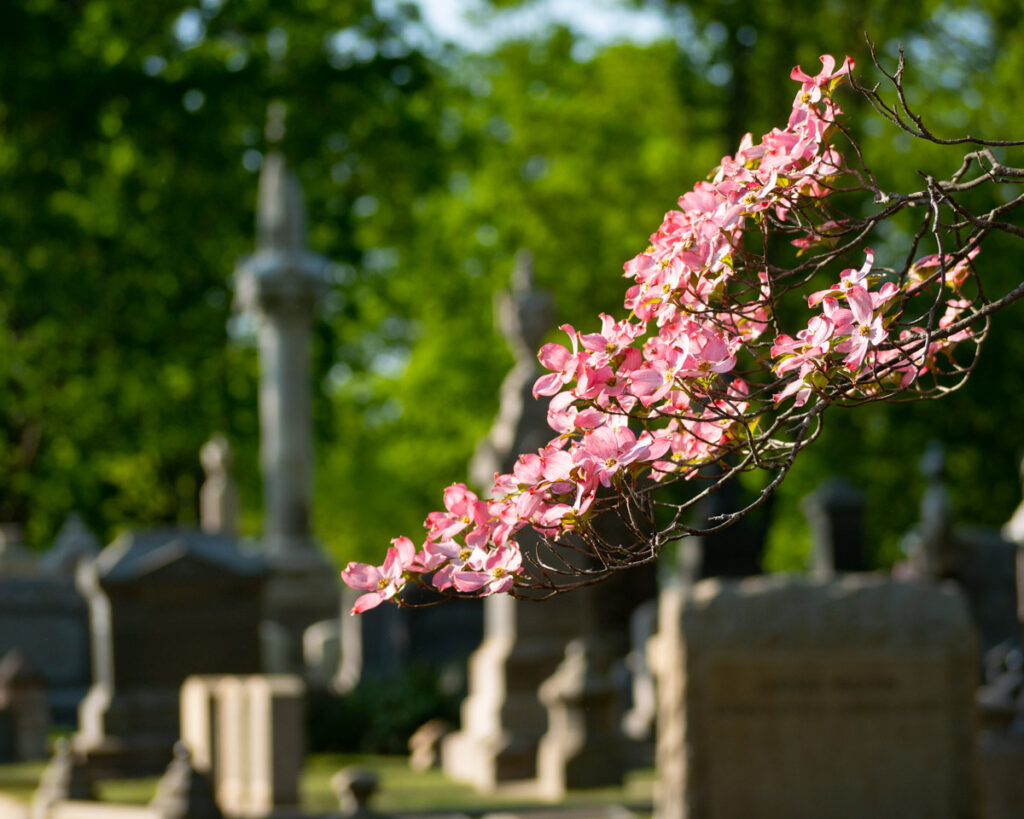
From that short excursion, I wanted to share a comparison of two images of the same tree but photographed with wide-angle lens and a telephoto lens. There are a few reasons why you might choose to use one or the other. When in doubt, shoot them both.
The first reason you might choose a telephoto lens is because you can’t get close enough to your subject. I personally encountered that scenario a couple weeks ago, stopping to photograph cherry trees in bloom at a cemetery where the gates were locked. I photographed from outside the fence using a 100mm lens.
The second reason you might choose to use a telephoto lens is to control the background. The narrow field of view may enable you to exclude elements from the background. And a wide-angle lens can include more background, for more environmental context. In the two photos I’ve shared here, both the telephoto and the wide-angle image do show the environment context, but a telephoto also allowed me to exclude the tombstones entirely.
A third reason to choose either telephoto or wide-angle is depth perception. Wide-angle lenses commonly exaggerate distance; multiple subjects in the photograph appear to be farther apart, compared to using a longer/telephoto focal length. Conversely, telephoto lenses tend to compress distance, making multiple subjects (at different distances from the camera) appear closer together.
Lastly, when you have multiple subjects at very different distances, a telephoto lens combined with a small aperture may allow blurring the background – if that’s the effect you’re seeking to create. Both the images here employ an aperture about f\4.5.
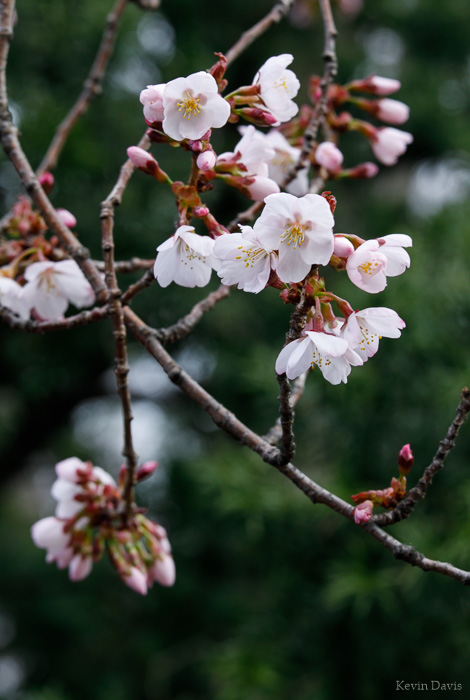
For some folks, the annual blooms of flowering trees are highly treasured. While other trees – magnolias, crabapple, etc – are spectacular, ornamental cherry trees are commonly deemed to be the pinnacle of flowering trees. In Japan, the word Hanami means the viewing enjoyment of flowers (hana), but specifically the blossoms of cherry trees.
In Tokyo Japan, the reported peak blooming occurred around March 22. In Washington D.C., it was March 28 this year. But here in the northeast USA, the blooming is just starting.
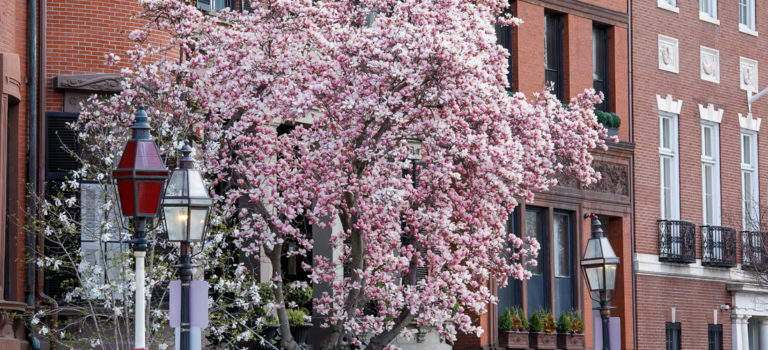
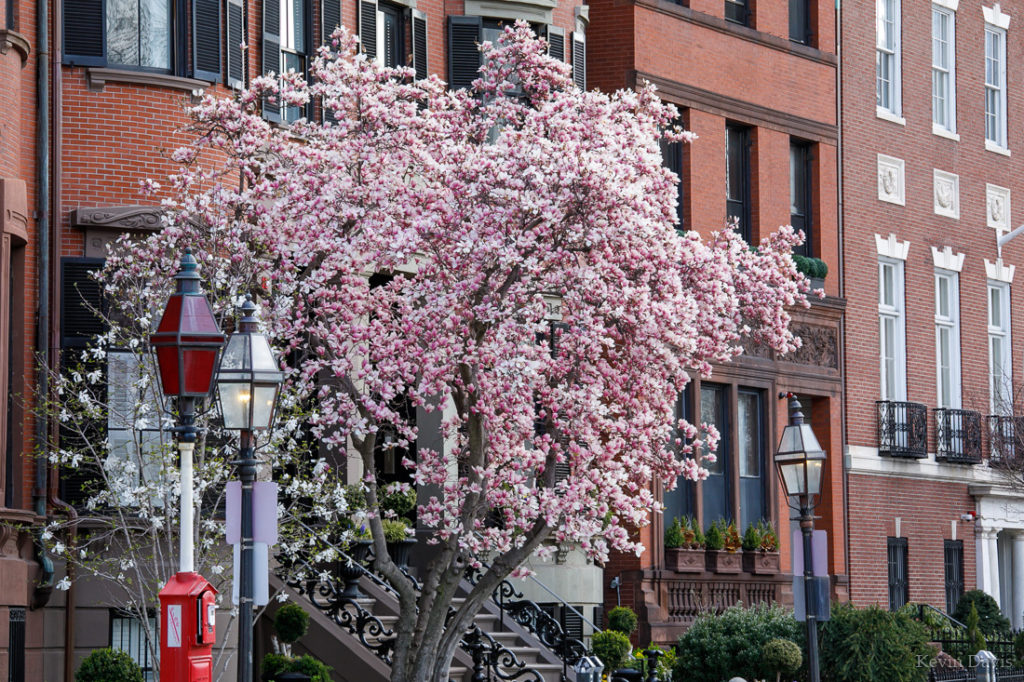
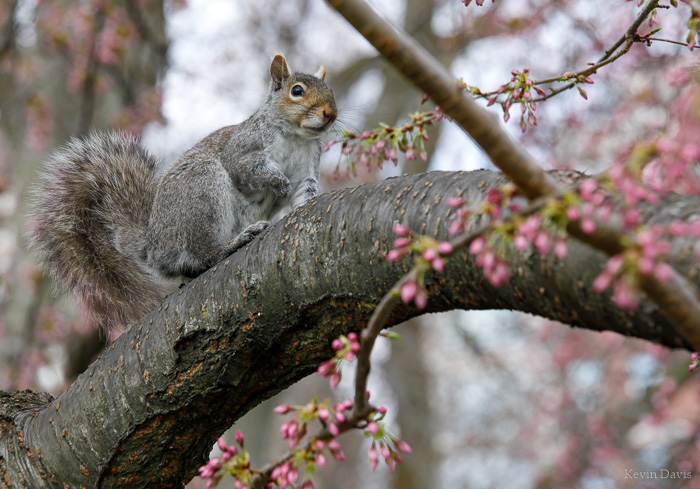
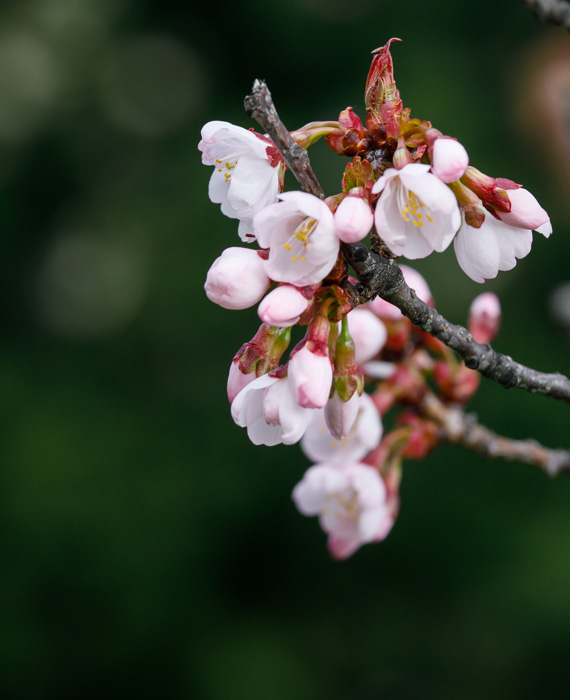
Here are a few samples from Boston this past weekend. The first photo is of a Saucer Magnolia in full bloom. The squirrel sits upon a Yoshino Cherry tree that has not yet bloomed at all. The close-ups are both Sargeant Cherry as it was just beginning to bloom.
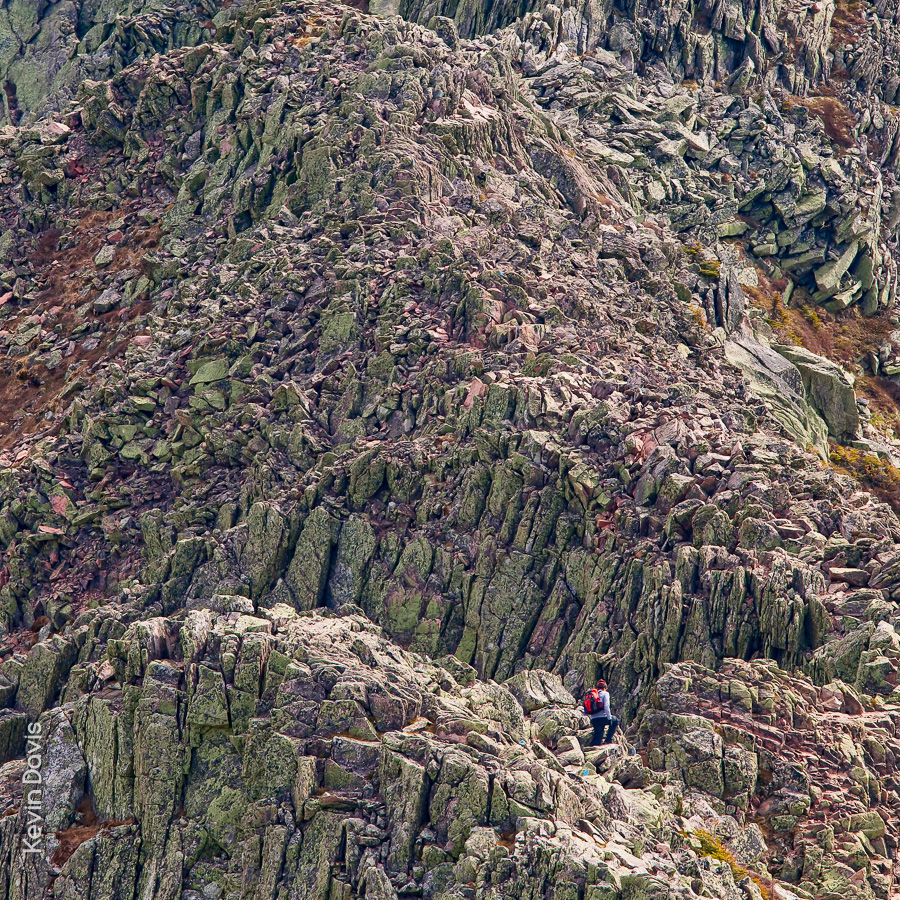
Mount Katahdin, northern terminus of the Applachian Trail
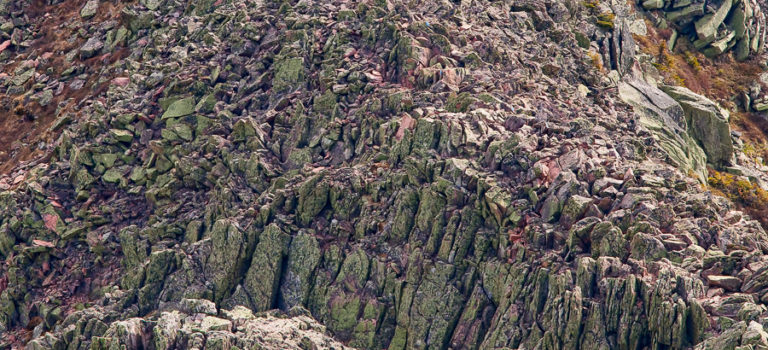
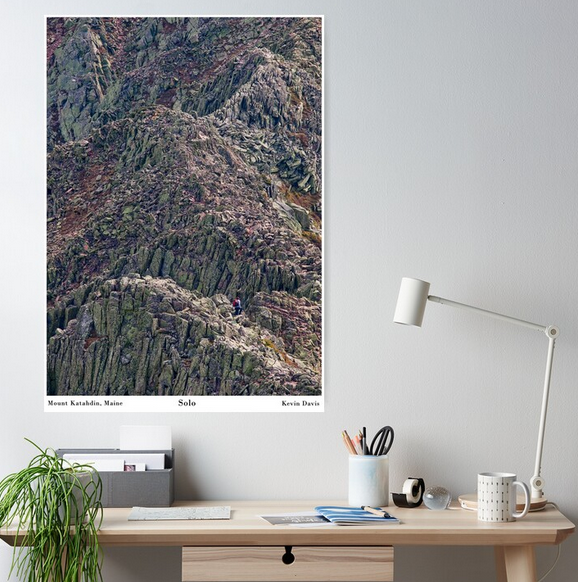
I’ve been thinking of turning this image into a wall poster and have finally done that. The scene is remarkable in particular because a solitary person appears quite small and provides the viewer a sense of scale. This mountain is unlike any other east of the Mississippi River.
I created this photograph during a solo visit to Katahdin. After spending the night at Chimney Pond, I arose early and ascended a very steep trail up to the top of the ridge. As a matter of lucky coincidence, this unidentified lone hiker happened to be about twenty minutes ahead of me.
Here’s what the medium-size poster looks like on my Redbubble store (https://www.redbubble.com/people/kevinheaven/shop).
April 19 – Boston
At the Public Garden, the flowering plum trees are solidly at peak bloom. Although some cherry trees are beginning to drop their flower petals, color will soon be reborn once the crabapples begin to bloom.
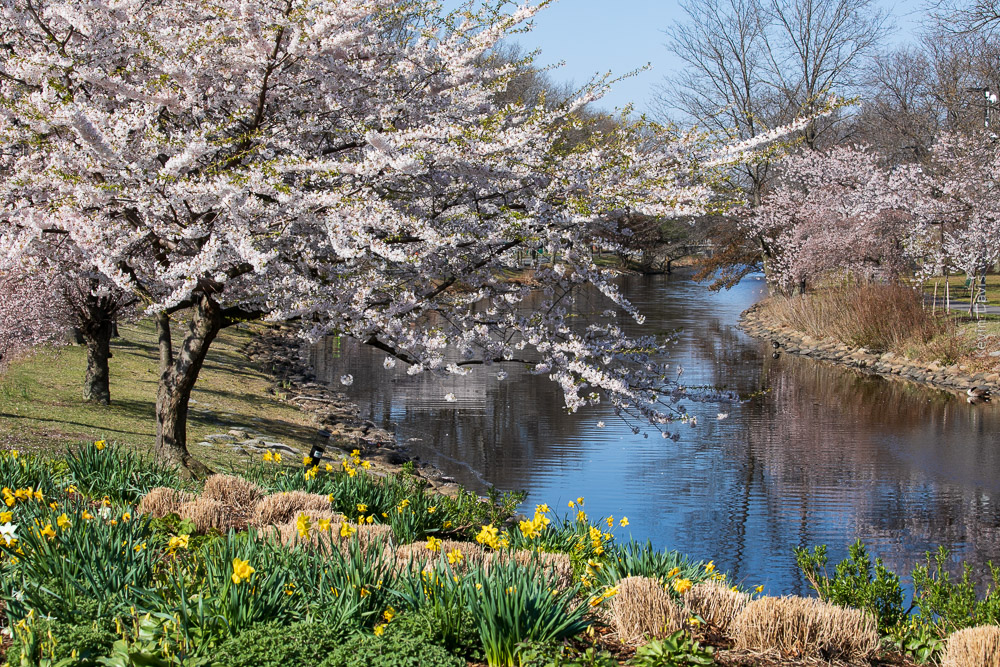
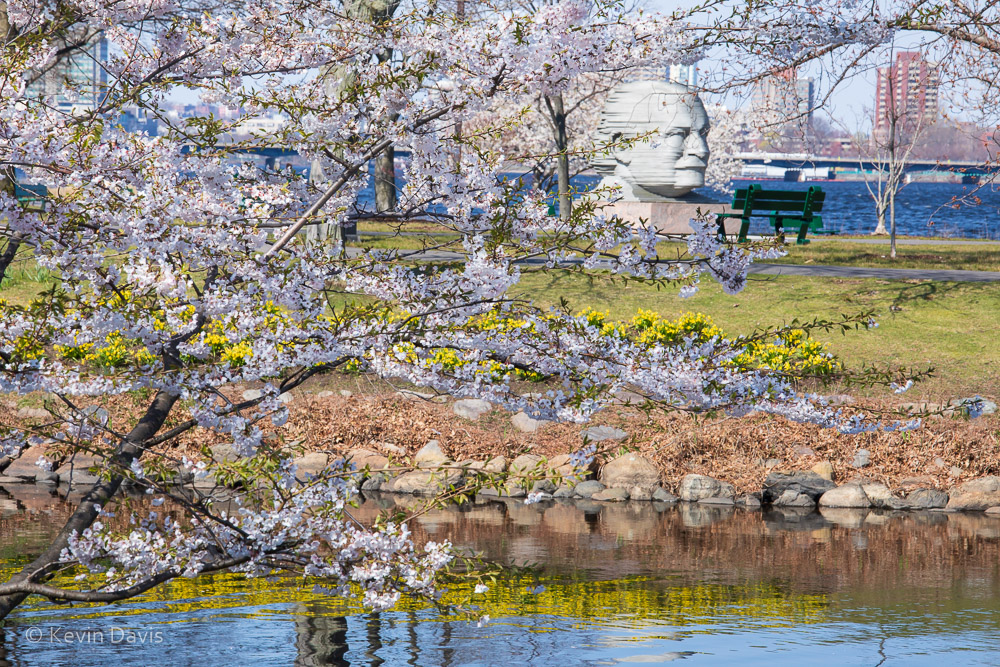
The jackpot of cherry trees is located nearby at the Charles River Esplanade. Here, multiple varieties of cherry trees are near peak bloom and should be giving a great display all this week. Of course, the Kwanzan Cherry trees (near the Hatch Memorial Shell) have not yet begun to bloom.
Charles River Esplanade, Boston Massachusetts
April 21 – Portsmouth, New Hampshire
Cherry trees near City Hall have not yet begun to bloom. Just across the street at Langdon Park, the prettiest tree in Portsmouth is just beginning to display the first few flowers. Downtown on State Street, flowing plum trees are displaying good color.