Bright colors. That’s pretty much what it’s all about when photographing amusement park rides. Daytime photographs pale in comparison to night photographs of the rides.
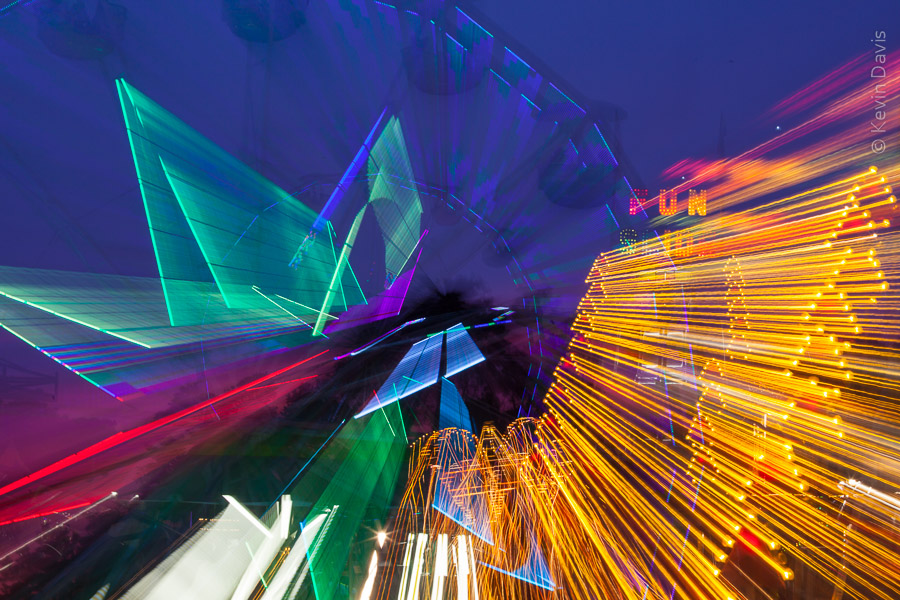
This photo here is from the Washington County Fair (Rhode Island). Although there was a fabulous pink sunset, I did not see it in time, so missed that photo opportunity. In this photo here, there is just a hint of the pink color in the bottom left background.
The best time is dusk. Just after the sun sets, there is still some light in the sky, but it’s darker than the lights, resulting in some contrast.
OK, so … it’s dark. Can your camera make a photograph? Sure. But you may need a long exposure, longer than 1/30 second. This shutter speed for this photo here is 1.3 seconds.
A slow shutter speed implies the camera could move slightly during the exposure and mess up the photo. So you need to stabilize the camera. Tripod is the right solution to this problem, but in this example here I had a monopod (just one leg). With the camera on the monopod, I braced it against something solid. A telephone pole will do; in my case, it was an above-ground pool, on display near the midway.
The last ingredient in this photo is, of course, the zoom effect. With the camera set to 2-second delayed shutter. I pressed the shutter button and poised my hand on the zoom ring of the lens. When the shutter clicked open, I rotated the zoom ring.